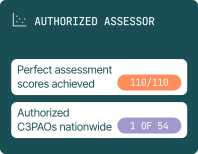
A DIBCAC High assessment carries higher stakes than a C3PAO assessment, and the margin for error is thinner. A DIBCAC High assessment measures your compliance with NIST SP 800-171, the requirement that flows down through DFARS 252.204-7012, and the score you earn during the week is the score you keep. We have seen it from every angle. We have led Joint Surveillance Voluntary Assessments alongside DIBCAC, one of our managers came to us straight from the DIBCAC assessor side, and we have sat in the hot seat and passed our own DIBCAC assessments twice.
A quick note before we start. This reflects our own experience and opinions, not official DIBCAC guidance, and interpretations can vary from one assessor to the next.
How Is a DIBCAC High Assessment Different from a C3PAO Assessment?
The core difference is room for error. A C3PAO assessment leaves more space for back and forth. DIBCAC comes, assesses, and the score at the end of the week is final. That single fact changes how you prepare for everything else.
During the assessment you get only a small number of corrections. The common description is five administrative changes with no technical changes allowed. Even DIBCAC members have disagreed on whether that means five documents or five separate instances where you can change whatever you need, so ask early. A lot of communication happens between you, your lead, and DIBCAC before the assessment begins, and that is the time to get the answer. When you do make a correction on the fly, still follow your change management process so you do not trip over your own procedures.
Why Does DIBCAC Care So Much About Documentation?
A common reaction is, I am actually doing the work, so why do I need to write a novel about it? The honest answer is that the government leans on documentation heavily. They want you to implement the requirement, and they want it written down. If there is no policy written down, business continuity suffers; if someone takes over your job tomorrow, they need your written processes and configuration steps to keep operations secure and consistent. Beyond that, the assessment objectives ask an assessor to identify, define, and describe what you do. That cannot happen without something written to point to.
So if you say you do something a certain way, you have to do it that way, every time, with no shifting left or right. On the C3PAO side an assessment can stall without documentation. On the DIBCAC side they keep going whether you wrote about it or not, which means the gaps in your writing quietly become gaps in your score.
Should You Write Your SSP to the 110 Requirements or the 320 Objectives?
Write to the 320 objectives. There are 110 requirements, but 320 assessment objectives sit beneath them. When an SSP has only 110 entries, the assessor has to jump into your policies and hunt for whether each objective is met, and details get lost along the way. When you speak to every objective directly, you answer the questions before they are asked and cut down on follow up and clarifying questions. In a DIBCAC assessment you cannot afford to have something get lost.
Does DIBCAC Use the CMMC Assessment Guide?
DIBCAC works from NIST SP 800-171A, the assessment companion to NIST SP 800-171. They use it to understand how each objective is assessed and what they are looking for. They do not lean on the CMMC-specific documentation the way a C3PAO does. That said, if you are preparing, read the Department of War CIO’s CMMC Assessment Guide anyway. It carries extra definitions and clause detail you will not find in 800-171 or 800-171A, and there is no reason to leave that information on the table.
What Is the Golden Rule During the Assessment Itself?
Answer the question, then stop talking. That is the whole flow. You answer, you stop, and the assessor decides whether they have enough. If they need more, they will ask. If they tell you something is trending met, say nothing else and move to the next requirement. Volunteering extra information only introduces risk, because now the assessor has more surface to question.
Silence is uncomfortable, especially when you are all sitting in a room together. We know the feeling. We do this for a living and still had to bite our tongues during our own assessment. Say what you need to say, then let them tell you if they need more. Meet the intent and move on.
How Should You Practice Before a DIBCAC Assessment?
Run a full self-assessment and rehearse it out loud. Have someone play the assessor, ask you a question, and make you find the evidence and show it live. Screenshot the path so you can get back to it under pressure. You should be the subject matter expert on your own environment. If an assessor asks how authorized users get into your environment and you answer with, I think we have a policy for that, it reads as suspicious and invites more questions.
Practice also surfaces two failure modes we see often. The first is the wrong person in the room. If you tell the assessor that a certain person pulls logs every day, that person needs to pull a log on demand. When they cannot, it undercuts the whole claim. The second is the wording of the objective. Maintenance, for example, asks about controls for tools, techniques, and mechanisms. If you are asked how you control the mechanisms and you answer with your techniques, you have not answered the question. Rehearsal is where you catch yourself talking in circles and decide whether a screenshot would say it more cleanly.
Prepare your inputs ahead of time too. Review your inventories and baselines even if it is not officially time to do so, run your self-assessment, and clear your ticket queues, pending changes, and service requests. During assessment week you may be answering end-of-day requests for screen grabs until eight or nine at night, so you do not want to be chasing routine work on top of that. Run the log captures most likely to come up, and make sure you already have a procedure for every log that pertains to a control. None of it should surprise you.
What Does DIBCAC Expect for Inheritance?
Objective-level detail, prepared in advance. Where a C3PAO might accept a broad statement that you inherit a large piece of Access Control from a third-party application and sort out the specifics later, DIBCAC wanted individual inheritance mapped at the assessment objective level for every item, ready before the first face-to-face Teams meeting. Build that out early rather than planning to explain it in the moment.
Why You Want an Expert in Your Corner
DIBCAC will not defend or argue the wording they assess against. At the same time, there are often many ways to meet a single requirement. If you are meeting the intent but cannot articulate it in the language the assessor expects, you can end up trending not met on something you actually satisfy. Someone who has spoken this language for years can hand you the right wording in the moment, and that matters because you do not get a redo. When the week ends, the score is the score.
The escalation path is also short. In our own assessment, an assessor disagreed with us on one control, we escalated to the assessment team lead, and the lead agreed with us. That worked, but there was not much recourse beyond the team lead. DIBCAC assessors are human and vary like any others. Some want more detail, some want less, and some read a control differently than you do.
Does CCA or CCP Training Improve Your Assessment Outcome?
In our experience, yes. The highest-scoring DIBCAC assessment our manager ever sat on had someone in the room who truly understood 800-171A, because the company had put them through training specifically to speak to it. On the assessment side, when a team includes someone with CCP or CCA knowledge, the evidence aligns better with what we are looking for, the terminology lands, and the whole assessment moves faster.
You do not have to become a certified assessor to get the benefit. You can take the roughly forty-hour CCA or CCP training through an authorized training partner on the Cyber AB marketplace without sitting for the certification. There can even be organizational risk to having staff hold an active assessor certification while they work for you. A consultant who already carries that background and experience gives you the same edge, which is one reason organizations with strong consulting support tend to fare better in both DIBCAC and Level 2 assessments.
Practical Logistics for Assessment Week
A few small things smooth out the week.
- Use multiple monitors. Run the conversation on one screen and keep your SSP, the control in question, and supporting documents on another. That way you can speak the exact wording of your own policies and never contradict your documentation out loud.
- Share the entire screen. Pick one screen and share all of it rather than a single window. Swapping windows breaks the cadence, and the assessor can always follow your mouse when the whole screen is visible.
- Save your spare file transfer links. The government tends to send two Safe Access File Exchange links every time it needs a document. Keep the extras. They usually last about a week and they come in handy.
- Line up the right people by day. DIBCAC was good about telling us which families would be assessed on which days, so we kept our virtual CISO on standby for the days he might be pulled in. Communicate early and often. In our experience DIBCAC is more accommodating than people expect, and early communication opens the door to scheduling flexibility.
- Organize your evidence first. Clean, well-organized evidence sent ahead of time is one of the earliest signals that an assessment will go well. Digging around live for meeting minutes reads as disorganized and lowers the assessor’s confidence. Collect your meeting minutes in one folder and keep a list of when you performed recurring tasks. Objectives that rest on administrative controls usually need more than a single screenshot to hold up, so be ready with deeper evidence through interview, test, or examine.
This is where doing the work continuously pays off. We run our own environment on the cybersecurity maintenance checklist built into the Kieri Compliance Documentation and Kieri Reference Architecture, logging weekly, monthly, quarterly, and annual tasks as we go. During our assessment it mapped to so many controls that assessors would start answering for us, pointing to the checklist before we finished the sentence.
What Happens with a POA&M in a DIBCAC High Assessment?
This is one of the real differences between a CMMC Level 2 assessment and a DIBCAC High. A POA&M in CMMC, defined in 32 CFR Part 170, covers the case where you scored short of the full 110 but showed enough security to earn a 180-day window to finish the remaining work, keep your score in SPRS, and stay eligible for contracts while you close the gap.
On the DIBCAC side, that option has been narrower. DIBCAC used to allow POA&M closeouts and then stopped, so the score you earned during the week was the score you kept. They may revisit that, and we would not want to speak for them. Here is the part worth knowing. When DIBCAC approaches a company for a High assessment, that company is sometimes offered the chance to do a CMMC Level 2 assessment through a C3PAO instead, which puts the POA&M option back on the table. If you are given that choice, it is worth weighing.
Passing a DIBCAC High Assessment Comes Down to Preparation
Most DIBCAC failures we have seen came down to preparation, not capability. Documentation written to every objective, an environment you can speak to without hesitation, the right people in the room, clean evidence staged in advance, and the discipline to answer the question and stop. Get those right and the week goes far better.
We have been through DIBCAC from every side, including our own two successful assessments, and we provide consulting to help you get ready. Note that we do not provide both consulting and a formal CMMC assessment to the same client, so if we help you prepare, we would point you toward another authorized assessor for your certification. Wondering whether your documentation and evidence would hold up under DIBCAC scrutiny? Schedule a free consultation with our certified CMMC assessors and we will walk through your readiness together.
Frequently Asked Questions
What is a DIBCAC High assessment?
A DIBCAC High assessment is a government-led review of your NIST SP 800-171 compliance, conducted by the Defense Industrial Base Cybersecurity Assessment Center against the 800-171A objectives. It carries higher stakes than a C3PAO assessment because there is little room to fix issues once the week begins.
How is a DIBCAC assessment different from a C3PAO CMMC assessment?
DIBCAC works strictly from 800-171A, expects deeper documentation prepared in advance, allows only a few administrative changes during the assessment, and has a shorter escalation path. The score at the end of the week is what you keep.
Should my SSP address the 110 requirements or the 320 objectives?
Write to all 320 assessment objectives. Addressing each objective directly reduces follow-up questions and keeps details from getting lost during the assessment.
Can you use a POA&M in a DIBCAC High assessment?
DIBCAC stopped offering POA&M closeouts, so the score you earn is the score you keep. A CMMC Level 2 assessment through a C3PAO does allow a POA&M under 32 CFR Part 170, and companies are sometimes offered that route instead.
Does CCA or CCP training improve your outcome?
In our experience, yes. Having someone who understands 800-171A in the room aligns your evidence with what assessors expect and speeds the assessment. You can take the training without becoming a certified assessor.