

Microsoft 365 GCC High and CMMC Compliance
If you handle Controlled Unclassified Information, the Microsoft cloud you pick decides a lot about your CMMC assessment. This guide compares commercial Microsoft 365, GCC and GCC High, explains what the CMMC rule asks of cloud providers and shows how a GCC High tenant has to be configured to meet NIST SP 800-171.
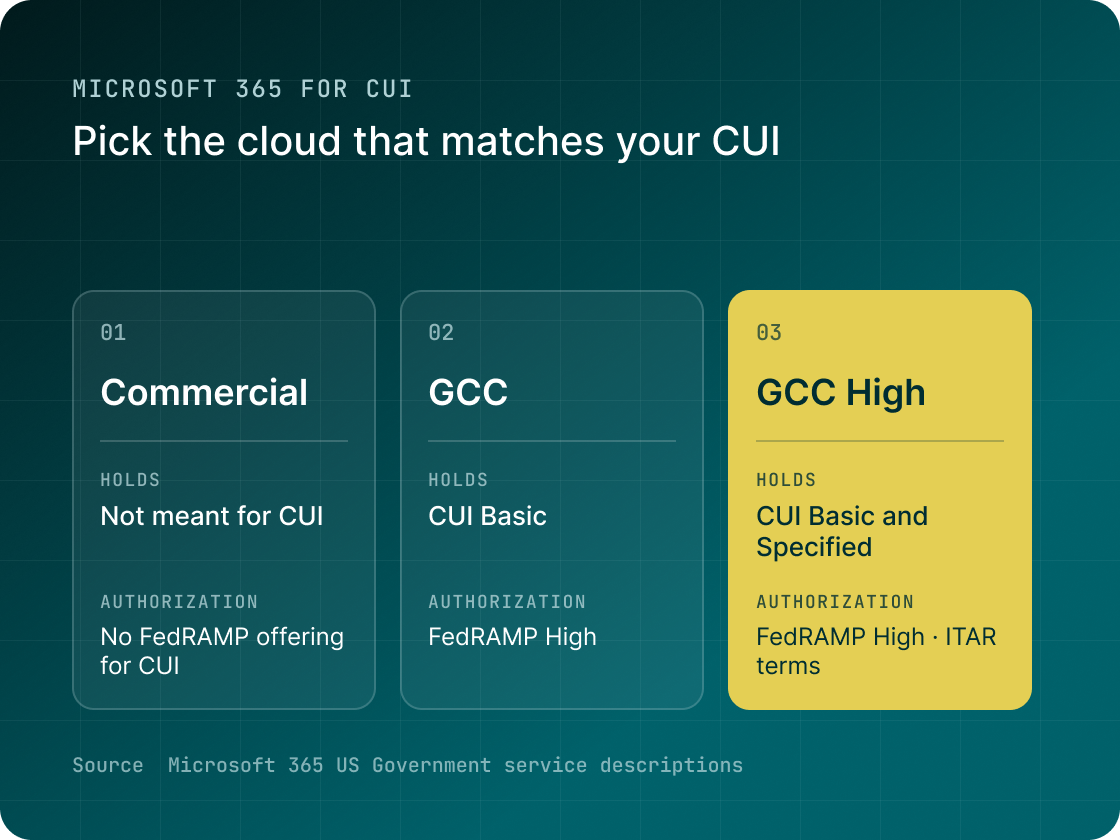
- Microsoft positions GCC for CUI Basic and GCC High for CUI Specified, including ITAR technical data. Commercial Microsoft 365 isn't meant to hold CUI.
- Any cloud service that stores, processes or transmits CUI has to meet FedRAMP Moderate or an equivalent under DFARS 252.204-7012. GCC and GCC High are both FedRAMP High.
- A GCC High license doesn't pass an assessment on its own. Assessors look at how the tenant is configured against NIST SP 800-171.
Which Microsoft 365 environment you need
The answer comes from your contracts and the kind of CUI you handle. Start with the lists below, then check them against the clauses and flow down terms in your own contracts.
GCC High is the safer choice when
- Your contracts involve ITAR or EAR controlled technical data
- You handle CUI Specified, which carries handling rules beyond the basic level
- Your prime has named GCC High in its flow down requirements
- You want Microsoft’s contractual DFARS and ITAR commitments to cover your email and files
GCC may be enough when
- You handle CUI Basic and no export controlled data
- Your contracts don’t call for a specific Microsoft cloud
- Your prime hasn’t asked for GCC High
Commercial Microsoft 365 is the wrong place for CUI
Microsoft doesn’t offer commercial Microsoft 365 for CUI. If CUI sits there today, plan a move to GCC or GCC High before you schedule a CMMC assessment.
Commercial Microsoft 365 vs GCC vs GCC High
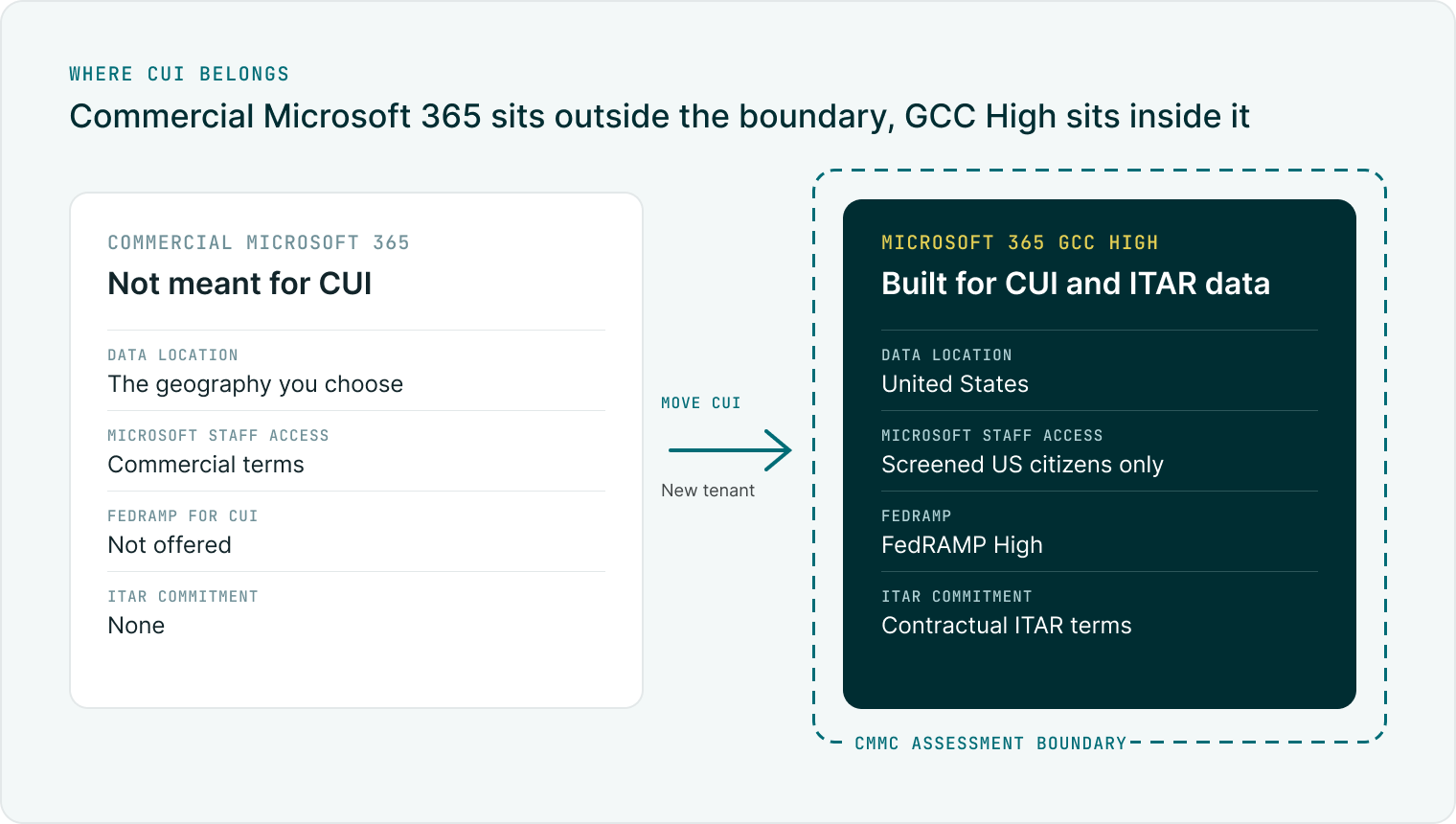
Microsoft runs these as separate environments. Moving from commercial to GCC High means building a new tenant and migrating your data into it, because a commercial tenant can’t be converted in place.
| Area | Commercial | GCC | GCC High |
|---|---|---|---|
| Meant for CUI | No | CUI Basic | CUI Basic and CUI Specified |
| FedRAMP | Not offered for CUI | FedRAMP High | FedRAMP High |
| DoD cloud level | None | DISA SRG Impact Level 2 | DISA SRG Impact Level 4 controls |
| ITAR | No commitment | No commitment | Contractual ITAR commitment |
| Where data is stored | The geography you pick | United States | United States |
| Microsoft staff access | Commercial terms | Screened staff, no standing access | Screened US citizens, no standing access |
| Infrastructure | Shared commercial cloud | Government community cloud | Separate sovereign cloud |
| Identity | Entra ID | Entra ID | Entra ID in Azure Government |
| Licensing cost | Lowest | Higher | Highest |
| Moving from commercial | Not needed | Tenant move or migration | New tenant and data migration |
Microsoft updates what each environment includes on a regular basis. Check the current Microsoft 365 US Government service descriptions for the specific services you plan to use. The Kieri Reference Architecture points to Microsoft’s documentation for settings that change.
Why GCC High fits defense contractors
GCC High exists because some defense data comes with rules about where it’s stored and who can reach it. Three things set it apart from the commercial service.
Data stays in the United States
Customer content in GCC High is stored in Microsoft datacenters in the United States and kept logically separate from commercial Microsoft 365.
Access is limited to screened US citizens
Microsoft staff don’t have standing access to GCC High. Anyone who needs temporary access to customer content has to pass background checks first, starting with citizenship verification.
The cloud is separate from commercial
GCC High runs in Microsoft’s US sovereign cloud, apart from the commercial service, with identity in Azure Government.
Cloud providers under the CMMC rule
The CMMC program rule in 32 CFR Part 170 treats cloud providers as external service providers. When a cloud service stores, processes or transmits CUI, it has to meet the requirements in DFARS 252.204-7012 (b)(2)(ii)(D). That means FedRAMP Moderate authorization or a FedRAMP Moderate equivalent, plus the clause’s incident reporting, malicious software, media preservation and forensic access terms.
The DoW explained what equivalent means in a December 2023 memo. A provider that isn’t FedRAMP authorized has to meet every control in the FedRAMP Moderate baseline, with the results confirmed by a FedRAMP recognized third-party assessment organization.
Providers that aren’t cloud services, such as a managed service provider that runs your systems, work differently. When they handle CUI or security protection data, they’re assessed as part of your environment. Either way, every external service provider belongs in your System Security Plan, along with what it does and how CUI moves to and from it.
Configuring GCC High for CMMC
A GCC High license gives you the platform. The tenant still has to be set up to meet NIST SP 800-171, and these four areas take the most deliberate work.
Identity and access
Conditional Access requires multifactor authentication for every user and blocks devices that aren’t managed and compliant. Emergency access accounts are documented with their break glass procedure. App registrations are inventoried, and each one gets only the permissions it needs.
Keeping CUI in the tenant
Microsoft Purview data loss prevention rules stop CUI from leaving through email, Teams, SharePoint sharing or OneDrive sync. External sharing is turned off or tightly limited. Sensitivity labels mark and protect documents that contain CUI.
Audit logging and monitoring
Audit logging is turned on with retention that matches your policy. Microsoft Defender for Endpoint runs on every device that reaches CUI, and its events flow to your SIEM along with the audit log. Alerts cover failed sign ins, privilege changes and other events your team reviews.
Device compliance
Intune compliance policies check for BitLocker encryption, Defender protection and current patches before a device can open CUI. Devices that fail are blocked by Conditional Access until they’re fixed.

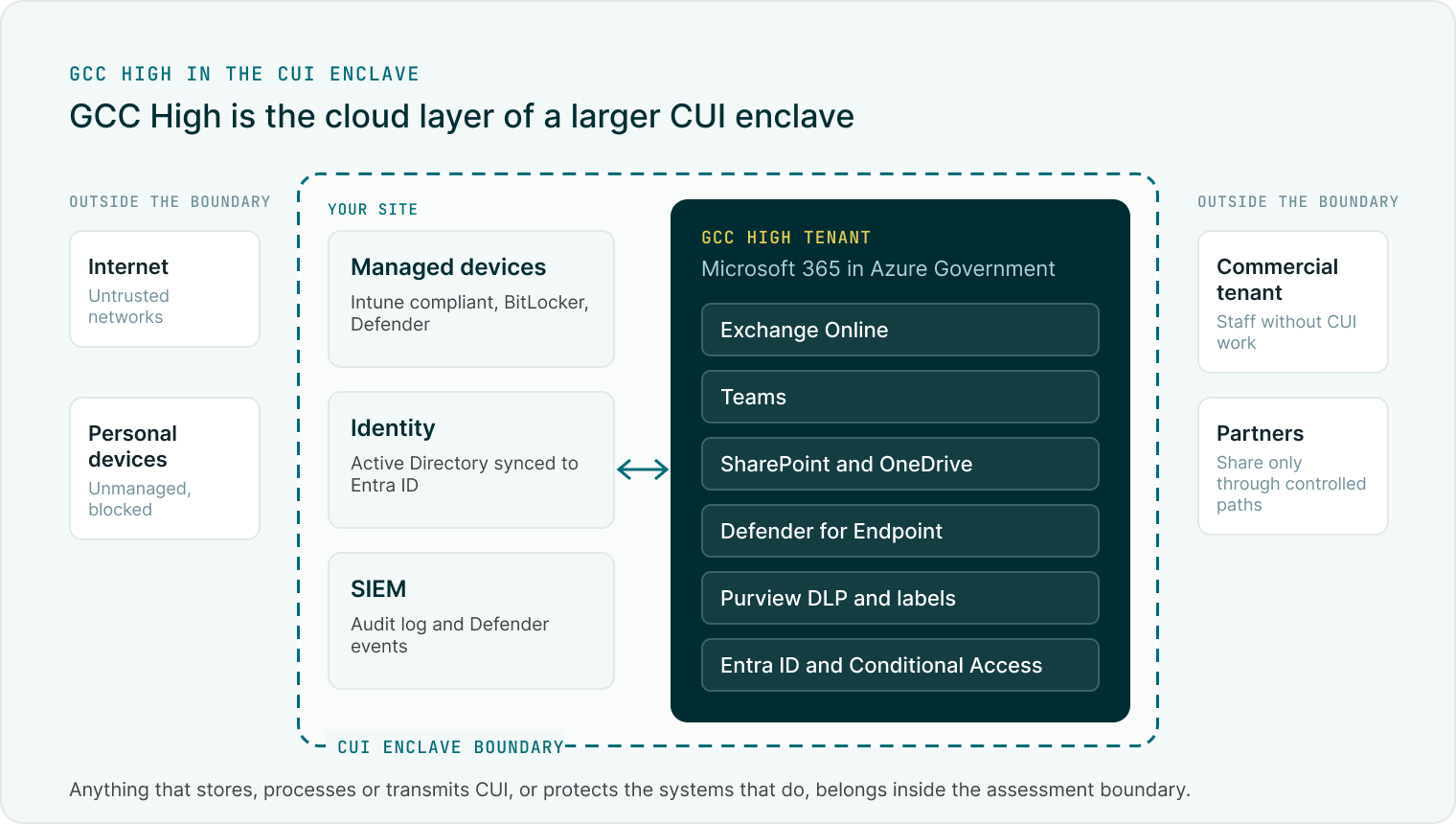
GCC High inside the CUI enclave
GCC High is the cloud part of a larger CUI enclave. It holds email, chat and documents for the people who work with CUI. The devices, identity sync and monitoring around it decide where CUI lives and how it moves, so they sit inside the same assessment boundary.
ITAR and GCC High
The International Traffic in Arms Regulations control the export of defense articles and services, including technical data. Many defense manufacturers hold ITAR data without labeling it that way.
Microsoft only agrees to ITAR contract terms for GCC High. There’s no ITAR certification for cloud services, so the commitment covers where data is stored and limits access to US persons. Whether your data is ITAR controlled is a legal question for export control counsel, and it should be answered before you pick a cloud.
Licensing for GCC High
Microsoft checks that an organization is eligible before it can buy GCC High. Licenses are bought through Microsoft or a partner authorized to sell US government cloud services. The plan you choose decides which tools you get, so check that it includes the ones your configuration depends on.
- Exchange Online, Teams, SharePoint Online and OneDrive
- Microsoft Defender for Endpoint
- Microsoft Purview data loss prevention and sensitivity labels
- Entra ID P2 for Conditional Access and Privileged Identity Management
- Intune for device compliance
What assessors check in GCC High
An assessor doesn’t stop at the license. They test whether the tenant meets the NIST SP 800-171 requirements tied to your cloud. These are the requirements that most often lead back to GCC High settings.
| Requirement | What it asks | Where it shows in GCC High |
|---|---|---|
| 3.1.1 and 3.1.2 | Limit access to authorized users and the functions they’re allowed | Entra ID accounts, roles and Conditional Access |
| 3.1.3 | Control the flow of CUI | Purview data loss prevention and sharing settings |
| 3.1.20 | Control connections to external systems | External sharing and guest access settings |
| 3.3.1 and 3.3.2 | Keep audit logs and trace actions to users | Audit log retention and SIEM forwarding |
| 3.5.3 | Use multifactor authentication | Conditional Access MFA policies |
| 3.13.16 | Protect CUI at rest | Service encryption and BitLocker on devices |
| 3.14.2 | Protect against malicious code | Defender for Endpoint deployment and policy |
Assessors also check that your SSP names GCC High as an external service provider and describes how CUI moves into and out of the tenant. Organizations that buy GCC High but skip this configuration work tend to find the gaps during assessment.
GCC High questions
We use commercial Microsoft 365 today. What does moving to GCC High involve?
You set up a new GCC High tenant, configure it to your baseline, then migrate mailboxes, Teams data, SharePoint sites and OneDrive files from the commercial tenant. The commercial tenant can’t be converted in place. How long it takes depends on how much data you have and how your current tenant is set up, so get a plan from your migration partner before you set an assessment date.
Do all of our users need GCC High licenses?
Usually only the people who access, create or send CUI. Others can stay on a separate system. In a small company where most people touch CUI, that ends up being most of the staff. Document the scoping decision in your SSP.
Can we use GCC instead of GCC High to save on licenses?
Possibly, if you handle CUI Basic only, with no ITAR or other CUI Specified data, and your contracts and prime don’t call for GCC High. Read the flow down terms in your contracts before you decide.
We already have GCC High. Is the cloud part covered?
Not by the license alone. The license gives you a FedRAMP High platform. Whether the tenant meets NIST SP 800-171 depends on settings like MFA enforcement, Conditional Access exceptions, audit log retention and Defender integration with your SIEM.
Does a CMMC Level 2 assessment look at our GCC High tenant?
Yes. The tenant is inside your assessment scope, so the assessor reviews its configuration against the requirements, along with how your SSP documents it as an external service provider.
Does Kieri migrate tenants to GCC High?
No. Kieri isn’t a managed service provider. The Kieri Reference Architecture specifies the GCC High configuration, and we can introduce you to an implementation partner for the migration and tenant build.
More CMMC technical guides
CUI Identification and Handling
What counts as CUI and where it lives in your systems.
Read the guide →
The System Security Plan for CMMC Level 2
What an assessor expects to read in your SSP.
Read the guide →
Your SPRS Score and What It Means
How the score is calculated and how to keep it current.
Read the guide →