

CMMC Deadlines and What the Dates Mean for Your Contracts
CMMC dates come from two separate rules and four phases. Phase 1 has been in effect since November 10, 2025. Phase 2 was set to start on November 10, 2026, but the DoW suspended it on July 13, 2026, and no new date has been announced. This guide lists each date, where it comes from and what it means for the contracts you hold today.
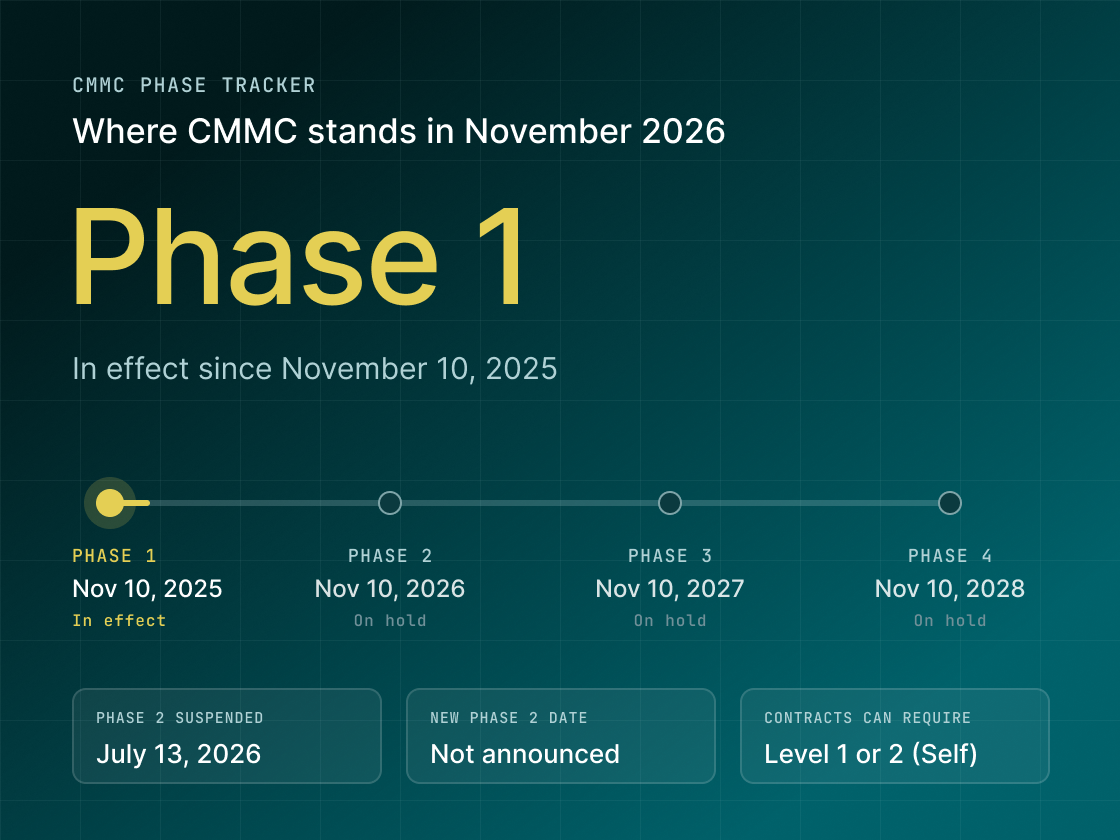
- Phase 1 of CMMC began on November 10, 2025, when the DFARS acquisition rule took effect. New contracts can require Level 1 (Self) or Level 2 (Self) status as a condition of award.
- Phase 2 was scheduled for November 10, 2026. The DoW suspended it on July 13, 2026, and hasn’t announced a new date. Phases 3 and 4 build on Phase 2, so they have no confirmed dates either.
- The suspension doesn’t touch DFARS 252.204-7012 or 7019. NIST SP 800-171 and a current SPRS score are still required in contracts that include those clauses.
Where the CMMC timeline stands today
As of November 2026, CMMC is in Phase 1. The acquisition rule that puts CMMC into contracts took effect on November 10, 2025. Since then, contracting officers can require Level 1 (Self) or Level 2 (Self) status before they award a contract.
Phase 2 would have added Level 2 (C3PAO) requirements to applicable contracts on November 10, 2026. On July 13, 2026, the DoW CIO issued a memo suspending the November 2026 Phase 2 transition while a CMMC reform task force reviews the program. A DFARS class deviation, now in its third revision, tells contracting officers to follow that memo.
Under the deviation, solicitations can include Level 1 (Self) or Level 2 (Self), and DFARS 252.204-7012 still requires NIST SP 800-171 Rev 2. Higher CMMC requirements come out of active solicitations through amendments, and out of existing contracts before the next option period or at the next scheduled modification. The rule text in 32 CFR part 170 didn’t change.
The two rules behind CMMC dates
Most confusion about CMMC deadlines comes from mixing up two rules. One created the program. The other put it into contracts.
The CMMC program rule, 32 CFR part 170
The DoW published the program rule in the Federal Register on October 15, 2024, and it took effect on December 16, 2024. It defines Levels 1, 2 and 3, how each one is assessed, how long a status lasts and what assessors and the accreditation body do. It let C3PAOs start formal Level 2 assessments, but it didn’t add CMMC to any contract.
The DFARS acquisition rule, 48 CFR
The acquisition rule, DFARS Case 2019-D041, was published on September 10, 2025, and took effect on November 10, 2025. It added DFARS 252.204-7021 and 252.204-7025, which are the clauses that put a CMMC level into a solicitation and a contract. Phase 1 started on that effective date, so every phase date is counted from November 10, 2025.
| Rule | Published | Effective | What it did |
|---|---|---|---|
| 32 CFR part 170 | October 15, 2024 | December 16, 2024 | Created the CMMC program and its three levels |
| DFARS Case 2019-D041 final rule | September 10, 2025 | November 10, 2025 | Put CMMC into contracts and started Phase 1 |
The four CMMC phases and their dates
32 CFR 170.3(e) sets out four phases, each starting one year after the one before it. Each phase widens which CMMC levels contracting officers can require.
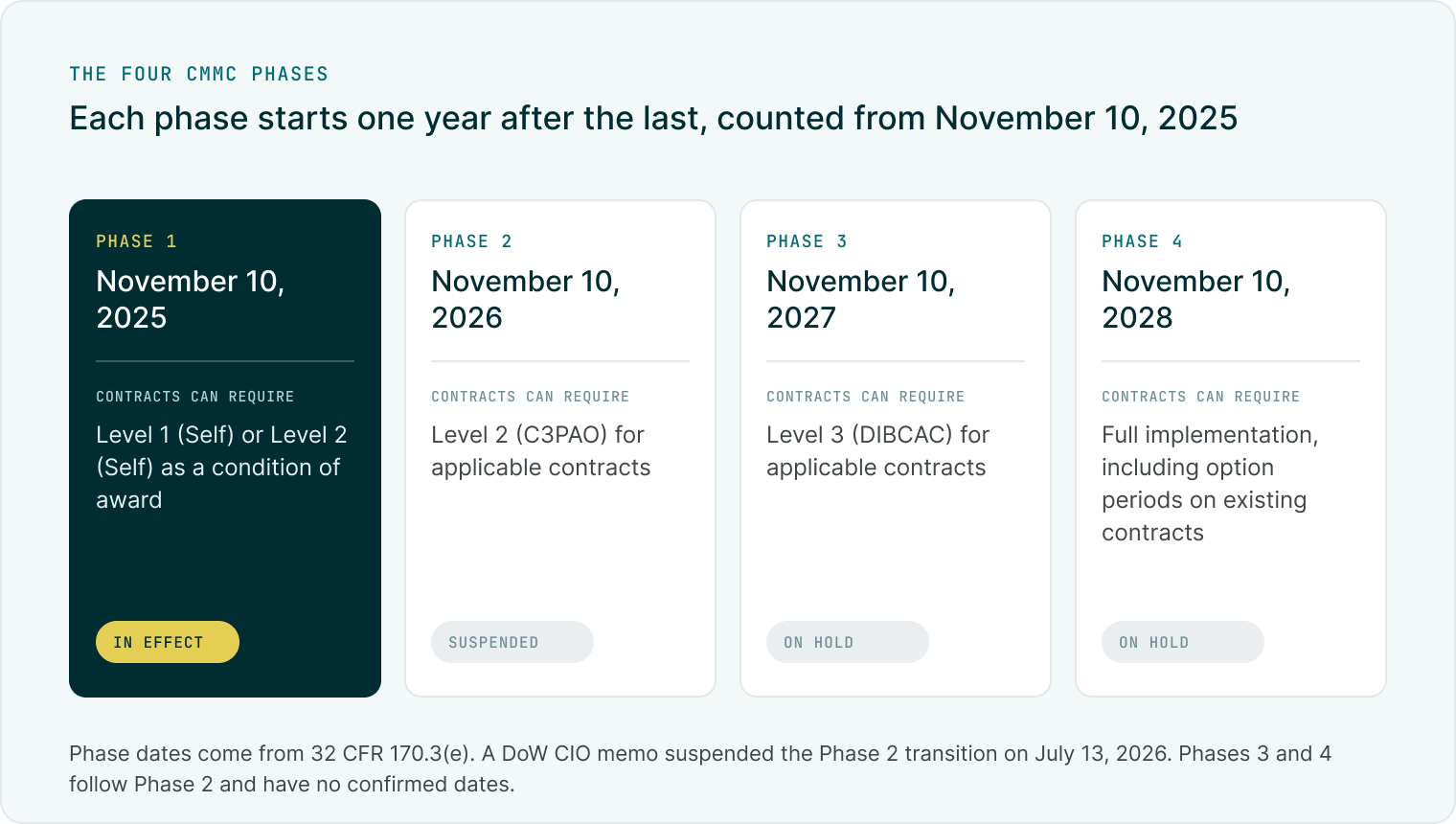
| Phase | Start date in the rule | What contracts can require | Status in November 2026 |
|---|---|---|---|
| Phase 1 | November 10, 2025 | Level 1 (Self) or Level 2 (Self) as a condition of award | In effect |
| Phase 2 | November 10, 2026 | Level 2 (C3PAO) for applicable contracts | Suspended July 13, 2026 |
| Phase 3 | November 10, 2027 | Level 3 (DIBCAC) for applicable contracts | On hold behind Phase 2 |
| Phase 4 | November 10, 2028 | Full implementation, including option periods on existing contracts | On hold behind Phase 2 |
A phase start is the first day a contract can include a requirement. If a solicitation issued during a phase includes a CMMC level, you need that status at award.
CMMC dates in order
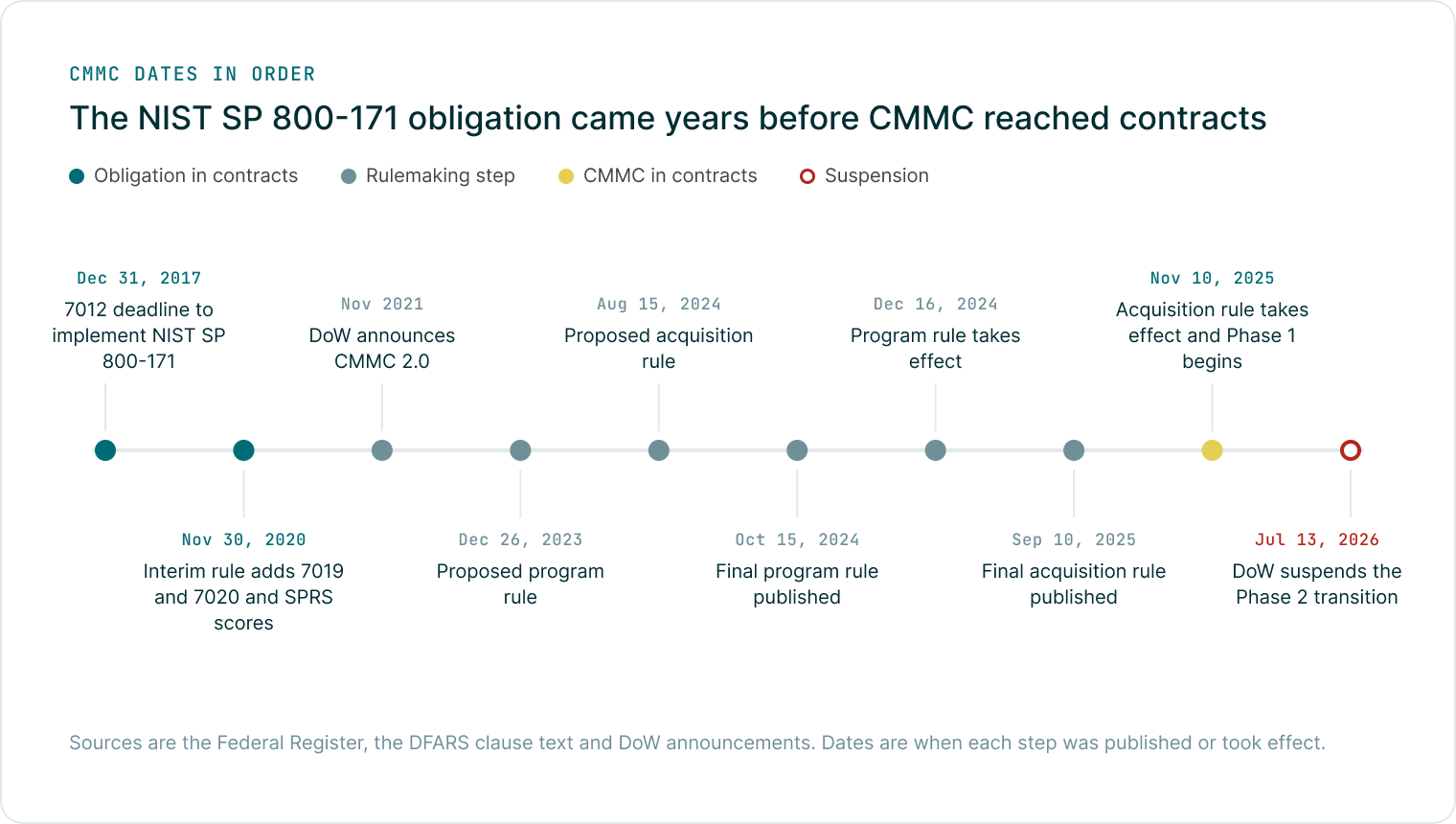
Several CMMC milestones fall in November or December of different years, which is why people often mean different things by “the November deadline.” Here’s each one in order.
| Date | What happened |
|---|---|
| December 31, 2017 | Deadline in DFARS 252.204-7012 for implementing NIST SP 800-171 |
| November 30, 2020 | DFARS interim rule took effect, adding 252.204-7019 and 7020 and the SPRS score requirement |
| November 2021 | DoW announced CMMC 2.0, cutting the model from five levels to three |
| December 26, 2023 | Proposed 32 CFR part 170 program rule published |
| August 15, 2024 | Proposed DFARS acquisition rule published |
| October 15, 2024 | Final 32 CFR part 170 program rule published |
| December 16, 2024 | Program rule took effect |
| September 10, 2025 | Final DFARS acquisition rule published |
| November 10, 2025 | Acquisition rule took effect and Phase 1 began |
| July 13, 2026 | DoW CIO memo suspended the Phase 2 transition |
If someone in your supply chain mentions a November deadline, ask which year and which rule they mean.
Obligations that already apply
The CMMC phases decide when a certification level can appear in a new contract. They don’t create a grace period for the cybersecurity clauses already in your contracts, and the Phase 2 suspension doesn’t change them either.
| Obligation | Clause | In place since |
|---|---|---|
| Implement NIST SP 800-171 on systems that hold covered defense information | DFARS 252.204-7012 | December 31, 2017 |
| Report cyber incidents to the DoW within 72 hours | DFARS 252.204-7012 | Contracts with the clause |
| Flow the clause down to subcontractors that handle covered defense information | DFARS 252.204-7012 | Contracts with the clause |
| Post a current NIST SP 800-171 score in SPRS before award | DFARS 252.204-7019 | November 30, 2020 |
| Give the DoW access for Medium and High assessments, and check that subcontractors have current scores | DFARS 252.204-7020 | November 30, 2020 |
These clauses are where False Claims Act cases come from. Penn State agreed in October 2024 to pay $1.25 million to resolve allegations that it didn’t meet its DoW and NASA cybersecurity requirements between 2018 and 2023. MORSECORP agreed in March 2025 to pay $4.6 million over allegations that included posting a SPRS score of 104 when its score was -142. Neither case needed a CMMC phase to begin.
What to do while Phase 1 is in effect
The work to get ready for Level 2 is the same whatever phase is active. Contractors who build their program now won’t have to rush when Phase 2 restarts.

If you haven’t posted a SPRS score
Start here. Assess your systems against NIST SP 800-171 using the DoD Assessment Methodology, post the score in SPRS and keep a plan of action for every gap. An accurate low score with a plan puts you in a far better position than no score.
If your score is below 110
Work through the gaps that carry the most points first. Multifactor authentication and other 5 point requirements move a score the most. A gap analysis shows which findings in your environment cost the most points and which ones are quickest to close.
If you self assessed at 110
A score of 110 says you’ve met all 110 requirements. Check that your evidence backs that up, because your company carries the risk if it doesn’t. A Level 2 (C3PAO) assessment confirms the score independently and gives you the status Phase 2 contracts will ask for once it restarts.
If you already hold Level 2 (C3PAO) status
Keep your program current. Post the annual affirmation, update your SSP when your environment changes and review any system change that touches CUI against your assessment scope.
CMMC deadline misconceptions
“The suspension means CMMC is over.”
Phase 1 is still in effect, and contracts can still require Level 1 (Self) or Level 2 (Self). The DoW paused Phase 2 for review, and both rules are still in place.
“If the deadline slips, we have more time.”
A slip moves the date a certification can be required. NIST SP 800-171 has been required under DFARS 252.204-7012 since 2017, and SPRS scores since November 30, 2020. Delaying that work adds exposure under the clauses you already have.
“We have until the end of a phase to comply.”
A phase is when a requirement can start appearing. Once a solicitation includes a CMMC level, you need that status at award.
“Our current contracts don’t mention CMMC, so we can wait.”
Existing contracts usually aren’t changed mid performance, but renewals, follow on awards and new task orders come under the CMMC clauses. Getting ready takes longer than most renewal cycles give you.
CMMC deadline questions
Is CMMC Phase 2 in effect?
No. Phase 2 was scheduled for November 10, 2026, but the DoW suspended it on July 13, 2026. As of November 2026 no new date has been announced, and solicitations can include Level 1 (Self) or Level 2 (Self).
Is my Level 2 (C3PAO) certification still valid?
Yes. The suspension doesn’t cancel certifications that have already been issued, and a Level 2 (C3PAO) status meets any contract that asks for Level 2 (Self).
My contracts don’t mention CMMC. Do I need to do anything?
If they include DFARS 252.204-7012 and 7019, you already need NIST SP 800-171 in place and a current SPRS score on file. CMMC adds a way to verify that work.
How do I know which CMMC level a contract will require?
The solicitation states the level, and your contracting officer is the source for it. Level 1 covers Federal Contract Information. Level 2 covers CUI. Level 3 is for a small set of programs the DoW designates.
We’re a subcontractor. Does the timeline apply to us?
Yes. DFARS 252.204-7012 and 252.204-7021 flow down to subcontractors that handle the same information, and your prime can ask for your status before it awards your subcontract.
Where can I check for official updates?
Rule changes appear in the Federal Register, and class deviations are posted by the DoW’s Defense Pricing, Contracting and Acquisition Policy office. The DoW CIO publishes CMMC program updates.
More CMMC technical guides
Your SPRS Score and What It Means
How the score is calculated and how to keep it current.
Read the guide →
NIST SP 800-171 Rev 2 and Rev 3
What changed between the revisions and which one your contracts use.
Read the guide →
The System Security Plan for CMMC Level 2
What an assessor expects to read in your SSP.
Read the guide →