

Your SPRS Score and What It Means
The Supplier Performance Risk System (SPRS) is where defense contractors report their NIST SP 800-171 score to the DoW. If your contracts include DFARS 252.204-7019, you need a current score on file before award. This guide explains how the score is calculated, what a low score signals, how to keep it current and how CMMC changes what shows in SPRS.
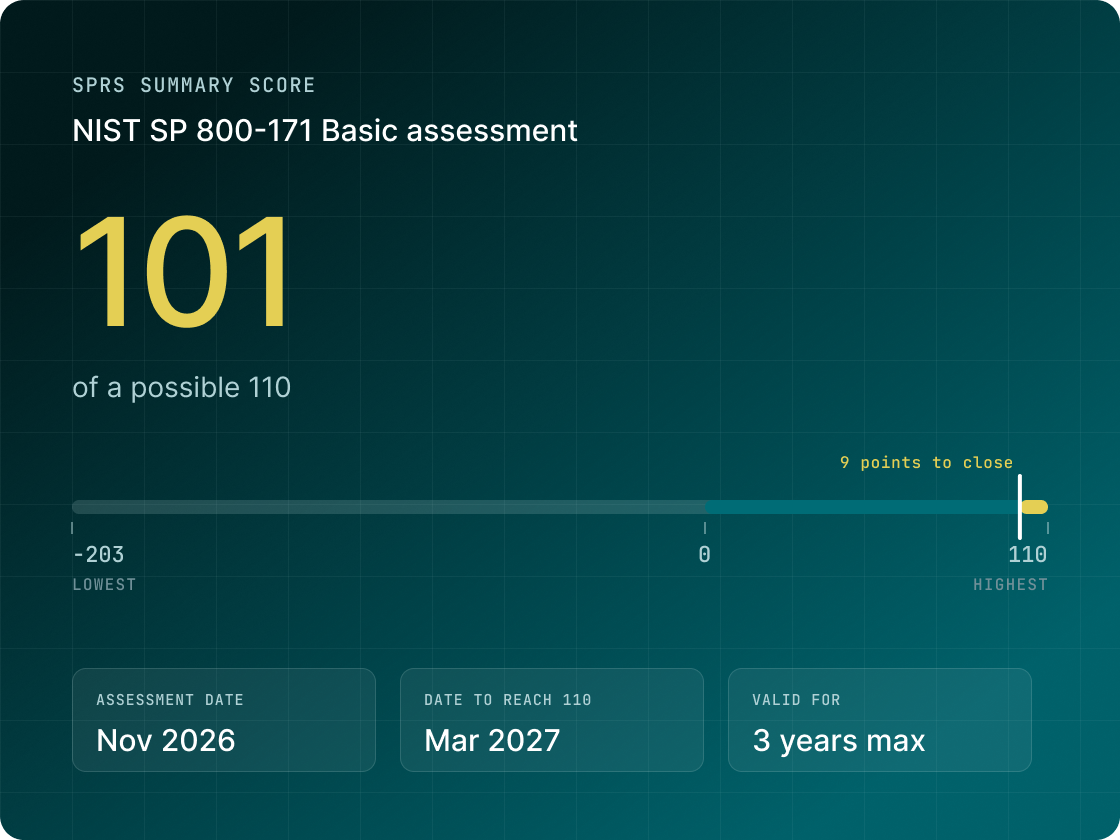
- Your SPRS score starts at 110 and drops by 5, 3 or 1 point for every NIST SP 800-171 requirement that isn’t fully met, down to a floor of -203.
- DFARS 252.204-7019 has required a current score since November 30, 2020, and a score can stay on file for three years at most.
- An accurate low score with a plan to close the gaps puts you in a far better position than an inflated score or no score at all.
What SPRS is
The Supplier Performance Risk System is the DoW database contracting officers check before they award a contract. Since November 30, 2020, DFARS 252.204-7019 has required contractors that handle covered defense information to post a summary score there from a NIST SP 800-171 assessment. Subcontractors fall under the same rule when the clause flows down to them.
A score of 110 means every one of the 110 requirements was assessed as met. Anything lower reflects gaps, and the score can drop as far as -203. A missing score means the assessment was never completed or never posted, which is a problem of its own under the clause.
How the SPRS score is calculated
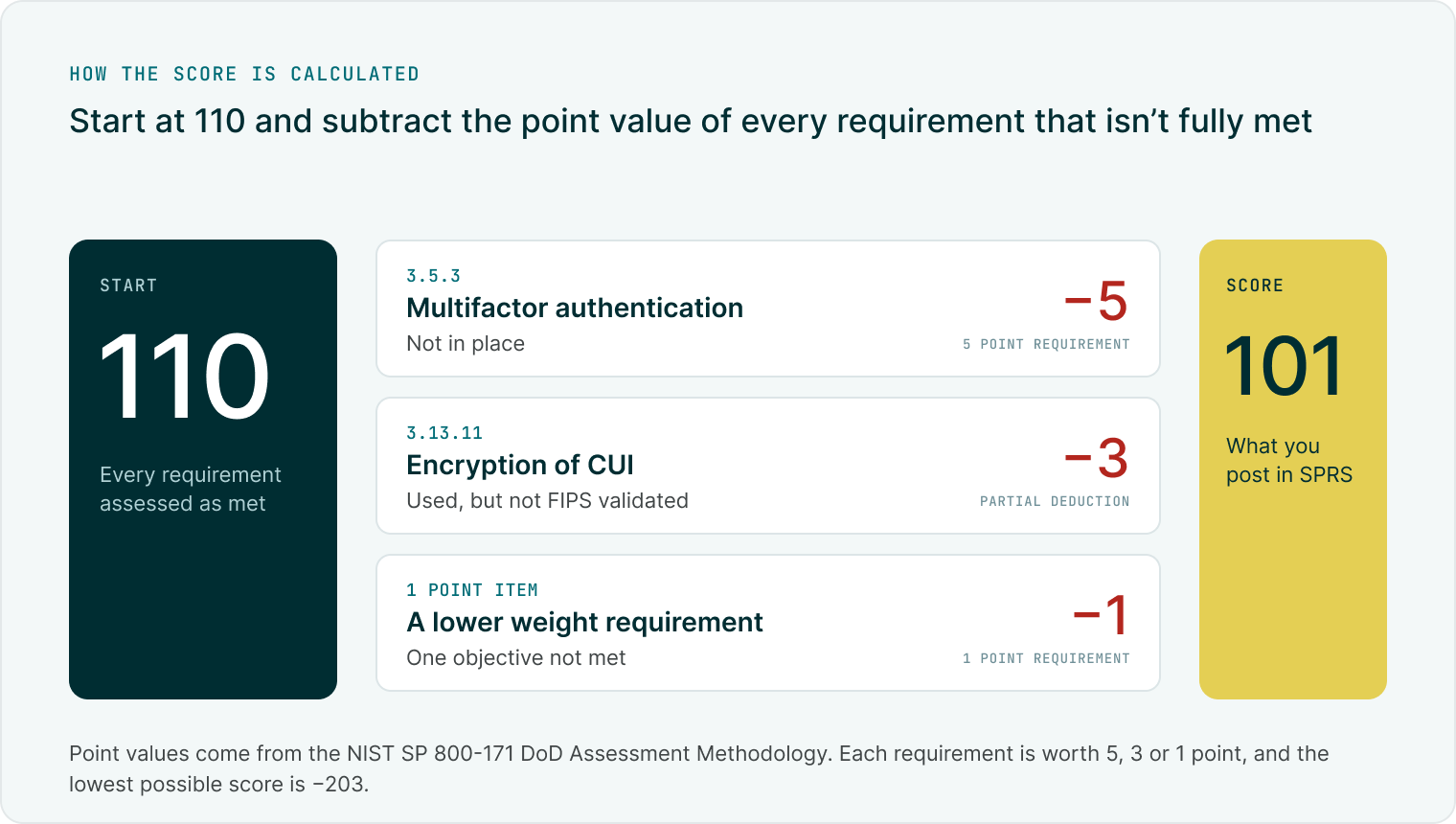
The scoring comes from the NIST SP 800-171 DoD Assessment Methodology, which the DoW publishes and DFARS 252.204-7019 points to. Every assessment starts at 110. For each requirement that isn’t fully met, you subtract its point value, which is 5, 3 or 1 depending on how much that requirement matters for protecting CUI.
The weighting is why a few findings can move a score so far. Missing a 5 point requirement such as multifactor authentication costs five times as much as missing a 1 point documentation item, so a company that has most of its program in place can still post a low number.
Partial credit is the exception
Two requirements allow a smaller deduction. For multifactor authentication (3.5.3), the deduction drops from 5 to 3 when MFA covers some of the required access but not all of it. For encryption of CUI (3.13.11), it drops from 5 to 3 when you use encryption that isn’t FIPS validated. Every other requirement is either met or not met.
Assessment objectives decide met or not met
NIST SP 800-171A breaks the 110 requirements into 320 assessment objectives. A requirement only counts as met when every one of its objectives is met, so a control that’s mostly in place still loses its full point value. It’s a common reason companies are surprised by their first accurate score.
The point value for each requirement is listed in the DoD Assessment Methodology, and Kieri’s gap analysis uses those exact values to project your score and show which fixes move it the most.
What your score tells a contracting officer
SPRS has no built in pass mark. Contracting officers and prime contractors read the number as a risk signal, next to the date you expect to reach 110. The table shows how we read scores during a gap analysis. It’s a rule of thumb from our assessments, and SPRS doesn’t publish bands like these.
| Score | What it usually means | What to do next |
|---|---|---|
| 110 | Every requirement is met | Keep your evidence current and reassess when your environment changes |
| 88 to 109 | A handful of gaps, often documentation or one technical control | Close the open items before you schedule a CMMC assessment |
| 50 to 87 | Material gaps, or several 5 point requirements missing | Plan structured remediation before you book an assessment |
| 1 to 49 | Large parts of NIST SP 800-171 aren’t in place yet | Treat it as a program build with owners and dates for every gap |
| 0 or below | Most of the high value requirements are missing | Start now, with the 5 point requirements first |
Who has to post a score
Any contractor with DFARS 252.204-7019 in its solicitation or contract needs a current score in SPRS before award. That covers companies that process, store or transmit covered defense information, which includes most CUI in DoW contracts, and it covers subcontractors when the requirement flows down to them.
Three DFARS clauses work together
- DFARS 252.204-7012 requires you to implement NIST SP 800-171 on the systems that handle covered defense information.
- DFARS 252.204-7019 requires a current SPRS score, no more than three years old, before award.
- DFARS 252.204-7020 lets the DoW verify your score through Medium and High assessments, and requires you to check that your subcontractors have scores too.

When to post and how to keep it current
Your score has to be on file before award of any contract that includes DFARS 252.204-7019, and it can’t be more than three years old. If it’s missing or expired when a contracting officer checks, that can cost you the award.
You don’t have to wait out the three years. Post a new score when you close gaps, when you change what’s in scope, when you add or remove systems that handle CUI, or when a contracting officer questions the number.
What you enter in SPRS
You post the summary score, the date the assessment was completed, the system security plan and CAGE codes it covers, and the date you expect to reach 110. Entries are made through the PIEE portal by someone with the SPRS Cyber Vendor User role, which your company’s PIEE administrator approves.
Self assessment or C3PAO assessment
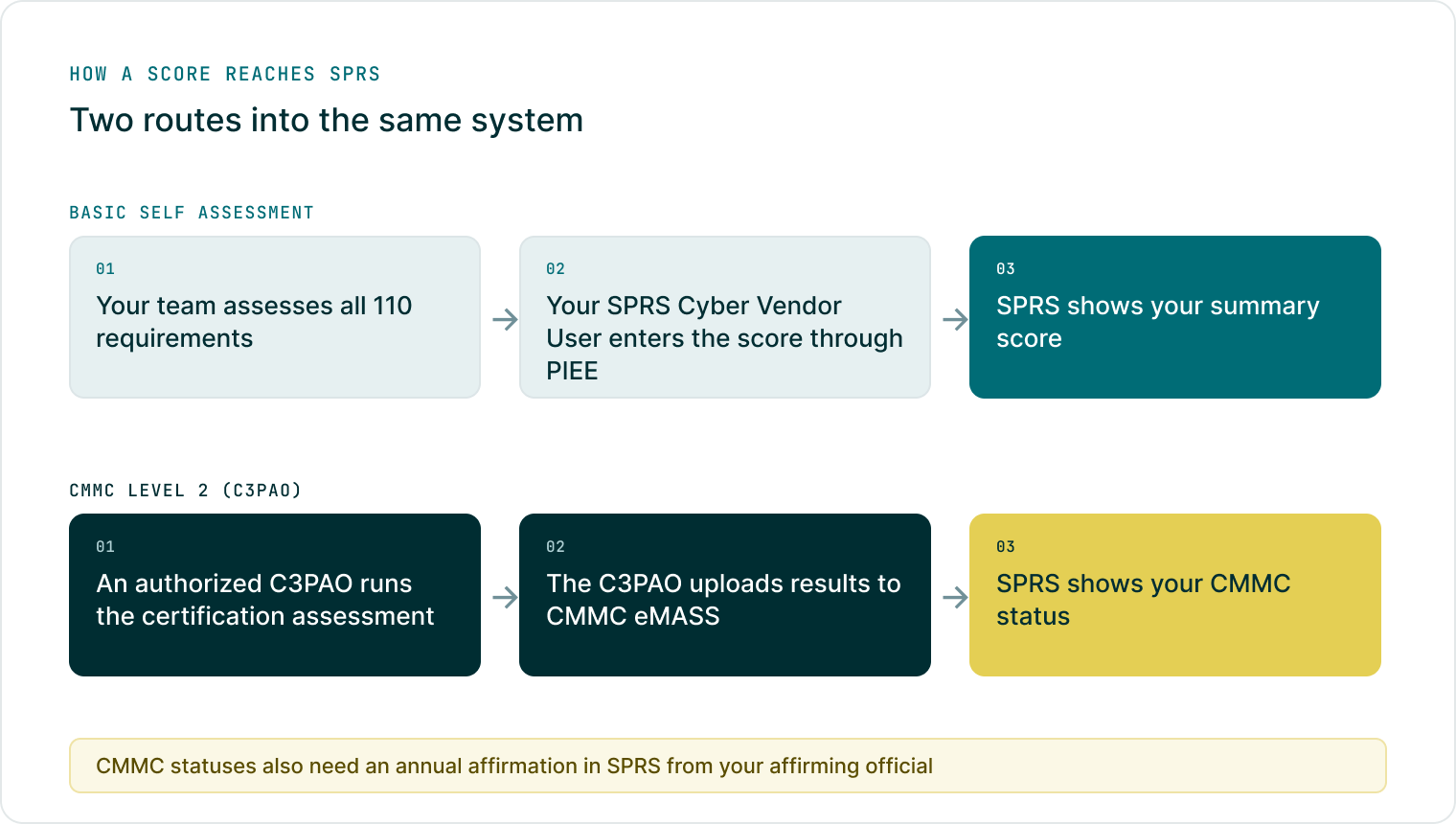
Both end up in SPRS, but they say different things. A Basic self assessment is your own review, entered by your team. A CMMC Level 2 (C3PAO) assessment is done by an authorized C3PAO, which uploads the results to CMMC eMASS, and your CMMC status then shows in SPRS.
| Basic self assessment | CMMC Level 2 (C3PAO) | |
|---|---|---|
| Who does it | Your own team | An authorized C3PAO with Certified CMMC Assessors |
| How it reaches SPRS | Your SPRS Cyber Vendor User enters it through PIEE | The C3PAO uploads results to CMMC eMASS, which feeds SPRS |
| Independent check | No | Yes |
| Who answers for accuracy | Your company, through the score you post | Your company still affirms every year, after an independent assessor has checked the work |
| When it fits | Contracts that call for a Basic score or Level 2 (Self) | Contracts that call for Level 2 (C3PAO) |
The False Claims Act and SPRS
Posting a score is a representation to the government. If the score overstates your compliance and it helped you win or keep a contract, the company can face False Claims Act liability, which allows up to three times the government’s damages plus a penalty for each claim. Liability doesn’t require intent. Reckless disregard for whether the number is accurate is enough.
Recent settlements
- MORSECORP agreed in March 2025 to pay $4.6 million. The Department of Justice said the company posted a score of 104 in January 2021, a consultant later scored it at -142, and the SPRS entry wasn’t corrected until June 2023.
- Penn State agreed in October 2024 to pay $1.25 million to resolve allegations that it didn’t implement required controls on 15 DoD and NASA contracts and subcontracts.
- Aerojet Rocketdyne agreed in July 2022 to pay $9 million to resolve a whistleblower’s allegations that it misrepresented its compliance with DFARS cybersecurity requirements.
What creates risk in a SPRS entry
- A score based on a quick internal review instead of a check of every requirement
- A score that never covered all 110 requirements in your current environment
- Raising a score without a new assessment behind it
- An executive signing off without knowing what the number stands for
- Leaving a score in SPRS after your security posture has slipped
An accurate low score with a credible plan to close the gaps is a far better position than an inflated one. A missing score creates its own exposure, because it shows the clause hasn’t been met.
How SPRS relates to CMMC
SPRS reporting came first. DFARS 252.204-7019 has required a score since November 2020, so a company without one has been out of step with its contracts since 2020, well before CMMC.
CMMC adds verification. The CMMC acquisition rule took effect on November 10, 2025. On July 13, 2026 the DoW suspended the planned November 2026 move to Phase 2, so for now new contracts can require Level 1 (Self) or Level 2 (Self). Every CMMC status also needs an annual affirmation in SPRS from a senior official at your company.
A gap analysis prepares you for both. You get a projected score, findings for every requirement and objective, and the evidence trail to support your SPRS entry and your plan to close the gaps.
SPRS questions
We’ve never posted a SPRS score. Are we in violation?
If your contracts include DFARS 252.204-7019 or 7020, yes. Run an assessment, post an accurate score with your plan to close the gaps, and talk to legal counsel about earlier contract periods if you’re concerned.
Can we post a score ourselves, or do we need a third party?
You can post it yourselves. A Basic self assessment is how most contractors meet DFARS 252.204-7019. It doesn’t give you Level 2 (C3PAO) status, and your company carries the risk if the number is wrong.
Our score is low. Should we wait until it improves?
Post it now with your plan of action, then post a new score as you close gaps. Waiting for 110 leaves you without a record and adds exposure while you wait.
What is a POA&M, and does SPRS need one?
A Plan of Action and Milestones lists each requirement you haven’t met yet, what you’ll do about it, who owns it and when it will be done. NIST SP 800-171 requirement 3.12.2 calls for plans of action, and SPRS asks for the date you expect to reach 110, which comes from that plan. The plan stays with you, ready to show the DoW if asked.
Does a CMMC Level 2 certification update SPRS?
Yes. The C3PAO uploads the results to CMMC eMASS, which sends your CMMC status to SPRS. You still need to post the annual affirmation.
Our environment changed since our last score. What should we do?
Reassess and post a new score. A score can stay on file for up to three years, but it has to be accurate the whole time it’s there.
More CMMC technical guides
NIST SP 800-171 Rev 2 and Rev 3
What changed between the revisions and which one your contracts use.
Read the guide →
The System Security Plan for CMMC Level 2
What an assessor expects to read in your SSP.
Read the guide →
CUI Identification and Handling
What counts as CUI and where it lives in your systems.
Read the guide →